
It’s almost too easy.
Use sensory words that tap into sight, sound, touch, taste, and smell, and your writing bursts to life in your reader’s mind.
And in this guide, I’ll show you how they work, how to use them without overdoing it, and how to turn flat writing into something readers can actually experience.
The power of sensory details
Remember the final scene in Field of Dreams when Ray Kinsella has a catch with his dad?
You can smell the grass on the field.
You can hear the sound of the baseball hitting their gloves.
And you can feel Ray’s years of guilt melting away as he closes his eyes, smiles, and tosses the ball back to his dad.

(Be honest. You’re crying right now, aren’t you?)
Field of Dreams made you feel like you were in Ray’s shoes, on his field, playing catch with dad.
The scene creates such a vivid sensory experience for many viewers that whenever they think of playing catch, this scene will come up alongside their own childhood memories.
Here’s why:
When you paint a strong scene in your reader’s imagination, you make it easier for them to pull it back up from their memory. You’ve essentially bookmarked it for them so they can easily find it when something — a sight, a smell, a sound — reminds them of it.
That’s the power of content that incorporates sensory details.
And this power isn’t limited to cinema classics capable of making grown men cry. For centuries, literary giants have been packing their prose with power words that evoke the senses:
“Cry ‘Havoc,’ and let slip the dogs of war;
That this foul deed shall smell above the earth
With carrion men, groaning for burial”
— William Shakespeare (circa 1599)
In addition to The Bard, authors like Maya Angelou, Edgar Allan Poe, and Charles Dickens excel at sensory writing. So do literally every famous poet you learned about in school.
And that begs the obvious question…
Why do sensory words work?
Short answer:
The brains of human beings handle sensory words differently than ordinary words.
In a 2011 study published in The Quarterly Journal of Experimental Psychology, experts found that our brains process “tangible” (i.e. sensory) words faster than other words.
And in a study published for Brain and Language in 2012, psychologists found that a certain part of our brain is “activated” when we read sensory words.
In other words:

So, we know why sensory details are powerful. And we know writers have been tapping into their power for a long, long time.
Now let’s break down the different types:
1. Sight words
Sight words are related to vision and describe the appearance of something (its color, size, shape, and so on).
Her golden hair looked disheveled thanks to the gust of wind.
He was a towering presence.
I ordered a large orange juice, but the waiter brought me a teeny-tiny glass the size of a thimble.
2. Sound words
Words related to hearing often describe the sound they make (known as onomatopoeia), but this isn’t always the case.
He had a big, booming voice.
The sound of screeching tires was soon followed by the deafening sound of a car horn.
As I peeked under the bed, the cackling laughter coming from the closet made the hairs on my arms stand up.
3. Touch words
Touch words describe the texture of how something feels. They can also describe emotional feelings.
Two minutes into the interview, I knew his abrasive personality would be an issue if we hired him.
With a forced smile, I put on the itchy Christmas sweater my grandmother bought me.
The Hot Pocket was scalding on the outside, but ice-cold in the middle.
4. Taste words
Taste words are interesting. Though they can describe food, and tease your taste buds with their deliciousness, they’re often used in comparisons and metaphors.
It’s a bittersweet situation.
Her zesty personality caught Karl’s eye.
The scrumptious jalapeno poppers comforted Karl after his bitter rejection.
5. Smell words
Words related to smell describe — yes, you guessed it — how things smell. Often underutilized, sensory words connected with smell can be very effective.
The pungent smell was unmistakable: someone in this elevator was wearing Axe Body Spray.
No matter the expiration date, it was clear from its rancid stench the milk had gone bad.
The flowery aroma was a welcome change after the elevator and milk incidents.
Note: Because they’re closely related, some sensory words can be used for both taste and smell. Examples: fruity, minty, and tantalizing.
Next, we’ll look at a few real-world examples of sensory details.
Sensory words in action
Imagine the following headline came across your Twitter feed:
How to Avoid Using Boring Stock Photo Images in Your Content
Would you click it?
Better question…
Could you read the headline without falling asleep?
The answers are probably “no” and “heck no.”
Now imagine you saw this headline:
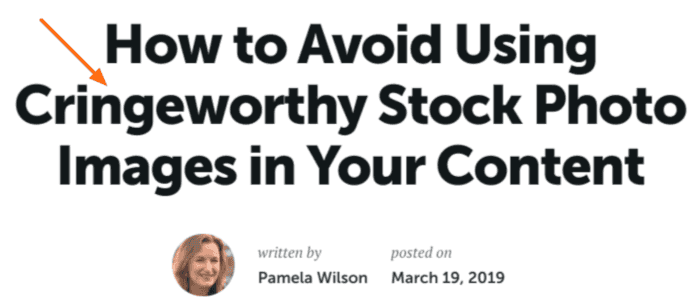
Much better, right?
The simple addition of the sensory word “cringeworthy” changes the tone of the entire headline. Instead of yawning, you’re thinking of an awkward or embarrassing moment you really don’t want to relive.
Let’s look at a few more modern-day examples of sharp people using sensory language to spruce up their content:
Using sensory words in author bios
I’ll pick on me for this one.
Here’s one of my old author bios:
Kevin J. Duncan is the Editor of Smart Blogger, where he helps writers learn the skills they need to land writing gigs that pay.
Now look at the author bio my friend Henneke wrote for 25+ Miracle Cures for Writer’s Block:
Henneke Duistermaat is an irreverent copywriter and business writing coach. She’s on a mission to stamp out gobbledygook and to make boring business blogs sparkle.
My bio is devoid of sensory words (or any interesting words at all, if we’re being honest).
Henneke’s is chock full of them.
Her bio is interesting.
Mine is boring.
The lesson? Add at least one sensory word to your author bio.
Using sensory words in social media profiles
Some people opt for brevity when writing their social media profiles, and that’s fine.
But if you want your X profile (or Facebook, Instagram, or any other social media profile) to stand out from the crowd, sprinkle in a sensory word or two.
Here’s an example from my badly-neglected Instagram account:

“Enchanting” and “adorably-jubilant” are wonderful sensory words — so wonderful, it’s a shame they’re wasted on a profile no one sees.
Look at your own profiles and see if there’s a place to add a sensory word or two. They’ll help your profile jump off the screen.
Heck, see if you can use enchanting and adorably-jubilant.
They deserve to be seen.
Using sensory words in introductions
The opening lines of your content are so important.
If you’re a student, your opening sets the tone for your teacher (who we both know is dying to use his red pen).
If you’re an author, your opening can be the difference between someone buying (and reading) your book or putting it back on the shelf in favor of one of those Twilight books (probably).
And if you’re a blogger, writer, content marketer, or business; your opening sentence can hook the reader’s interest (increasing dwell time, which is great in Google’s eyes) or send them scurrying for the “back” button.
It’s why we put such an emphasis on introductions here at Smart Blogger.
Sometimes our openings hook you with a question.
Sometimes we strike a note of empathy or (like this blog post) focus on searcher intent.
And sometimes we give you a heaping helping of sensory words:
Imagine you’re sitting in a lounge chair on the beach, staring out over the glittering sea, the ocean breeze ruffling your hair, listening to the slow, steady rhythm of the waves.
In the above opening for How to Become a Freelance Writer, Starting from Scratch, Jon Morrow uses figurative language to set a scene for the reader.
And it’s highly, highly effective.
Using sensory words in email subject lines
Like you, your readers are flooded with emails.
And with open rates in a steady decline, people are trying anything and everything to make their email subject lines stand out:
- Emojis;
- Capitalized words;
- All lowercase letters;
- Two exclamation points;
- Clickbait that would make even BuzzFeed go, “that’s too far, man.”
You name it, people are trying it.
Want a simpler, far-more-effective way to help your emails stand out from the crowd?
Add a sensory detail.
Brian Dean loves to include words like “boom” in his subjects:

The folks at BDOW! (formerly SumoMe) regularly feature descriptive words in their subjects and headlines.
Here’s one example:

And descriptive language appears in most everything Henneke writes, including her subject lines.
In this one she also uses an emoji related to her sensory word. Very clever:

Now that we’ve covered several examples, let’s dig a bit deeper…
Let’s discuss some practical steps you can take that will make adding figurative language to your own writing style a breeze:
How to add sensory details to your writing
If you’ve taken a good English or creative writing class, you’ve probably been told a time or two to “show, don’t tell.”
This means you should create an engaging experience for your target audience, not just tell them what you want them to know.
You accomplish this by using descriptive writing that conveys sensations and lets readers experience your words (rather than simply read them).
And how do you do that, exactly?
Ask yourself these five questions when you’re writing:
What do you see?
It isn’t enough to tell your readers there was a scary house in your neighborhood when you were a child. Describe the house to them in vivid sensory detail.
What shade of gray was it?
Were the doors boarded up?
Precisely how many ghostly figures did you and the neighbor kids see staring at you from the upstairs bedroom windows, and how many are standing behind you right now?
Paint a mental image for your readers.
What do you hear?
We listen to uptempo songs to push us through cardio workouts. Many of us listen to rainfall when we’re trying to sleep. Some of us listen to Justin Bieber when we want to punish our neighbors.
Want to transplant readers into your literary world?
Talk about the drip, drip, drip of the faucet.
Mention the squeaking floors beneath your feet.
Describe the awful music coming from your next-door neighbor’s house.
How does it feel?
Touch sensory words can convey both tactile and emotional sensations.
Can you describe to the reader how something feels when touched? Is it smooth or rough? Round or flat? Is it covered in goo or is it goo-less?
Paint a picture for your reader so they can touch what you’re touching.
The same goes for emotion. Help the reader feel what you (or your character) are feeling. Draw them in.
What does it taste like?
Does the beach air taste salty? Is the roaring fire so intense you can taste the smoke? Is the smell of your roommate’s tuna fish sandwich so strong you can taste it from across the room?
Tell your audience.
Be descriptive.
Make them taste the fishiness.
What does it smell like?
It wasn’t a basement you walked into — it was a musty, moldy basement.
And you didn’t simply enjoy your Mom’s homemade lasagna. You inhaled the aromatic scents of sauce, cheese, and basil.
Evoking the sense of smell is possibly the most effective way to pull readers out of their world and into yours.
So when you sit down to write, ask yourself if it’s possible to describe how something smells. And if you can? Do it.
The sensory words list (583 and counting)
Once you’ve asked and answered the five questions above, your writing will start adding sensory words naturally.
In time, you’ll build your own list of sensory words you can come back to (no thesaurus needed).
But in the meantime, here’s mine.
Bookmark it.
Print it.
Use it when you need it:
185 sight words
| Angular | Little |
| Azure | Lofty |
| Billowy | Long |
| Black | Low |
| Bleary | Malnourished |
| Bloated | Maroon |
| Blonde | Massive |
| Blue | Miniature |
| Blurred | Misshapen |
| Blushing | Misty |
| Branching | Motionless |
| Bright | Mottled |
| Brilliant | Mountainous |
| Broad | Muddy |
| Brown | Murky |
| Brunette | Narrow |
| Bulbous | Obtuse |
| Bulky | Olive |
| Camouflaged | Opaque |
| Chubby | Orange |
| Circular | Oval |
| Colorful | Pale |
| Colorless | Peered |
| Colossal | Petite |
| Contoured | Pink |
| Cosmic | Portly |
| Craggy | Pristine |
| Crimson | Prodigious |
| Crinkled | Purple |
| Crooked | Quaint |
| Crowded | Radiant |
| Crystalline | Rectangular |
| Curved | Red |
| Dark | Reddish |
| Dazzling | Rippling |
| Deep | Rotund |
| Dim | Round |
| Dingy | Ruby |
| Disheveled | Ruddy |
| Distinct | Rusty |
| Drab | Sabotaged |
| Dreary | Shadowy |
| Dull | Shallow |
| Dusty | Shapeless |
| Elegant | Sheer |
| Enchanting | Shimmering |
| Engaging | Shiny |
| Enormous | Short |
| Faded | Silver |
| Fancy | Skinny |
| Fat | Small |
| Filthy | Smudged |
| Flashy | Soaring |
| Flat | Sparkling |
| Flickering | Sparkly |
| Foggy | Spherical |
| Forked | Spotless |
| Freckled | Spotted |
| Fuzzy | Square |
| Gargantuan | Steep |
| Gaudy | Stormy |
| Gigantic | Straight |
| Ginormous | Strange |
| Glamorous | Striped |
| Gleaming | Sunny |
| Glimpse | Swooping |
| Glistening | Tall |
| Glitter | Tapering |
| Glittering | Tarnished |
| Globular | Teeny-tiny |
| Gloomy | Tiny |
| Glossy | Towering |
| Glowing | Translucent |
| Gold | Transparent |
| Graceful | Triangular |
| Gray | Turquoise |
| Green | Twinkling |
| Grotesque | Twisted |
| Hazy | Ugly |
| Hollow | Unsightly |
| Homely | Unusual |
| Huge | Vibrant |
| Illuminated | Vivid |
| Immense | Weird |
| Indistinct | White |
| Ivory | Wide |
| Knotty | Wiry |
| Lacy | Wispy |
| Lanky | Wizened |
| Large | Wrinkled |
| Lavender | Wrinkly |
| Lean | Yellow |
| Lithe |
161 sound words
| Babble | Noisy |
| Bang | Peeping |
| Barking | Piercing |
| Bawled | Ping |
| Bawling | Pinging |
| Bellow | Plopping |
| Blare | Pop |
| Blaring | Purring |
| Bleat | Quacking |
| Boom | Quiet |
| Booming | Rant |
| Bray | Rapping |
| Buzz | Rasping |
| Buzzing | Raucous |
| Cackle | Rave |
| Cackling | Ringing |
| Chatter | Roar |
| Chattering | Roaring |
| Cheer | Rumble |
| Chiming | Rumbling |
| Chirping | Rustle |
| Chuckle | Rustling |
| Clamor | Scratching |
| Clang | Scream |
| Clanging | Screaming |
| Clap | Screech |
| Clapping | Screeching |
| Clicking | Serene |
| Clink | Shout |
| Clinking | Shouting |
| Cooing | Shrieking |
| Coughing | Shrill |
| Crackle | Sigh |
| Crackling | Silent |
| Crashing | Sing |
| Creak | Singing |
| Croaking | Sizzling |
| Crow | Slam |
| Crunch | Slamming |
| Crunching | Snap |
| Crunchy | Snappy |
| Cry | Snoring |
| Crying | Snort |
| Deafening | Splashing |
| Distorted | Squawking |
| Dripping | Squeaky |
| Ear-piercing | Stammer |
| Earsplitting | Stomp |
| Exploding | Storm |
| Faint | Stuttering |
| Fizzing | Tearing |
| Gagging | Thudding |
| Gasping | Thump |
| Giggle | Thumping |
| Giggling | Thunder |
| Grate | Thundering |
| Grating | Ticking |
| Growl | Tingling |
| Grumble | Tinkling |
| Grunt | |
| Grunting | Twittering |
| Guffaw | Wail |
| Gurgle | Warbling |
| Gurgling | Wheezing |
| Hanging | Whimper |
| Hiss | Whimpering |
| Hissing | Whine |
| Honking | Whining |
| Howl | Whir |
| Hubbub | Whisper |
| Hum | Whispering |
| Humming | Whistle |
| Hush | Whooping |
| Jabber | Yell |
| Jangle | Yelp |
| Jangling | Mumble |
| Laughing | Mumbling |
| Moaning | Murmur |
| Monotonous | Mutter |
| Mooing | Muttering |
| Muffled |
123 touch words
| Abrasive | Lightweight |
| Balmy | Limp |
| Biting | Lukewarm |
| Boiling | Lumpy |
| Breezy | Matted |
| Bristly | Metallic |
| Bubbly | Moist |
| Bubby | Mushy |
| Bumpy | Numbing |
| Burning | Oily |
| Bushy | Plastic |
| Chilled | Pointed |
| Chilly | Powdery |
| Clammy | Pulpy |
| Coarse | Rocky |
| Cold | Rough |
| Cool | Rubbery |
| Cottony | Sandy |
| Crawly | Scalding |
| Creepy | Scorching |
| Cuddly | Scratchy |
| Cushioned | Scummy |
| Damp | Serrated |
| Dank | Shaggy |
| Dirty | Sharp |
| Downy | Shivering |
| Drenched | Shivery |
| Dry | Silky |
| Elastic | Slimy |
| Feathery | Slippery |
| Feverish | Sloppy |
| Fine | Smooth |
| Fleshy | Smothering |
| Fluff | Soapy |
| Fluffy | Soft |
| Foamy | Sopping |
| Fragile | Soupy |
| Freezing | Splintery |
| Furry | Spongy |
| Glassy | Springy |
| Gluey | Sputter |
| Gooey | Squashy |
| Grainy | Squeal |
| Greasy | Squishy |
| Gritty | Steamy |
| Gushy | Steely |
| Hairy | Sticky |
| Heavy | Stifled |
| Hot | Stifling |
| Humid | Stinging |
| Ice-Cold | Stony |
| Icy | Stubby |
| Itchy | Tangled |
| Knobbed | Tapered |
| Leathery | Tender |
| Light | Tepid |
| Unsanitary | Thick |
| Velvety | Thin |
| Warm | Thorny |
| Waxy | Tickling |
| Wet | Tough |
| Woolly |
51 taste words
| Acidic | Palatable |
| Appetizing | Peppery |
| Bitter | Pickled |
| Bittersweet | Piquant |
| Bland | Raw |
| Buttery | Refreshing |
| Charred | Rich |
| Contaminated | Ripe |
| Creamy | Salty/Salted |
| Crispy | Savory |
| Delectable | Scrumptious |
| Delicious | Stale |
| Doughy | Sugary |
| Earthy | Syrupy |
| Fermented | Tangy |
| Flavorful | Tart |
| Flavorless | Tasteless |
| Floury | Unripe |
| Garlicky | Vinegary |
| Gingery | Yummy |
| Gritty | Zesty |
| Hearty | Melted |
| Juicy | Nauseating |
| Luscious | Nutritious |
| Medicinal | Nutty |
| Mellow |
47 smell words (plus 16 taste and smell words)
| Ambrosial | Odiferous |
| Antiseptic | Odor |
| Aroma | Odorless |
| Aromatic | Old |
| Briny | Perfumed |
| Citrusy | Piney |
| Decayed | Polluted |
| Decomposed | Pungent |
| Doggy | Putrid |
| Fetid | Rancid |
| Floral | Rank |
| Flowery | Redolent |
| Foul-smelling | Reeking |
| Fragrant | Scent |
| Gamy | Scented |
| Gaseous | Sickly |
| Horrid | Skunky |
| Inodorous | Smell |
| Malodorous | Smoky |
| Mephitic | Stagnant |
| Musky | Stench |
| Musty | Stinky |
| Acrid | Sweaty |
| Burnt | Tempting |
| Fishy | Whiff |
| Fresh | Salty |
| Fruity | Sour |
| Lemony | Spicy |
| Minty | Spoiled |
| Moldy | Sweet |
| Mouth-watering | Tantalizing |
| Rotten |
Start using sensory details
Sensory details aren’t complicated.
You’re already using them… just not always on purpose.
The difference is intention. When you slow down and ask what something looks like, sounds like, or feels like, your writing starts to carry more weight. It becomes easier to picture. Easier to follow. Harder to forget.
You don’t need to use them in every sentence (and, on behalf of everyone, please don’t use them in every sentence).
But used in the right moments, they’re often what makes a line stick in the heads your readers.






Wow! Thank you so much for this post. Such a resourceful read!
Thank you! Glad you enjoyed it, Deepika. 🙂
Hey, this was a bomb!. thanks for these words! very powerful!! I am always looking for ways to convey imagery and make my speakings and writings come alive. Thanks for this!
You’re very welcome, Mantino. Glad you enjoyed it!
Thank you so much, Kevin. I was going to insert as many jubliants and enchantments as I could but that would tell you more about me than you.
Sincere thanks as I am in the midst of a fictional cozy which is as flat as a pancake and needs zesting and zinging up.
Allow me to wish you and yours a very Happy Easter before I leap back to my scribbling in order to elevate the prose, thanks to your help, to Shakespearian levels.
Hi Zara,
You’re welcome, and thank YOU for the very amusing comment. You worked in 7 or 8 sensory words. Nicely done. 🙂
Good luck on your writing project. I have no doubt you’ll reach Shakespearean levels!
Fantastic article Kevin , thank you.
I’m an English teacher in Vietnam and I’m forever telling my students to use sensory words like these but I forget to use them myself in my new blog ????. But this article reminded me to do just that !!
Hi Karen,
Thank you for the kind words! Glad you enjoyed it.
I was a teacher in a former life, so lots of respect for what you do. Hopefully this post can act as a resource for your students too! 🙂
Best and most useful article I’ve read in a while Kevin, thank you.
Hey Therese,
High praise! So happy you enjoyed it. 🙂
Hey Kevin,
There I was, avidly reading your cosmic post with all those dazzlingly scrumptious sensory words, when I stumbled across my own Twitter profile! You certainly put some oomph into my day and I’ll be bookmarking your dictionary of words for future reference. Thanks for the massive effort.
Cheers, Mel
Hey Mel,
Haha. You’re very welcome. To give you a little insight into how I (sometimes) gather sources:
I hopped into Twitter and clicked the link so I could see all of my followers. Then I scrolled and scrolled, looking to find someone with a profile that used sensory words.
And then I found you. “You can stop searching,” I told myself. “You found the one.” 😉
Glad you enjoyed the post, Mel. I’m really hopeful we’ll get a lot of traction with this one!
Awesome list Kevin, its an addition to Jon’s list of Power words.
Thank you so much for the awesome share.????
Hey Rajat,
Thanks! Yes, it’s my hope this post on sensory words will be a nice 1-2 punch alongside Jon’s power words. Fingers crossed. 🙂
Excellent post, Kevin. Your words motivated me to learn more about including sensory words into my writing. Keep it up!
Hi Cassidy,
Thank you! I’m glad it motivated you. They (sensory words) really are wonderful. Good luck implementing them into your writing! 🙂
Perfect timing, Kevin! Your post tiptoed into my inbox yesterday, then landed smack at the top of our CMC FB thread today. (How could I resist reading?) Besides, it’s brilliant. ‘Bookmark-worthy,’ as Jon said. So now you’ve thrown down the gauntlet: how many sensory words can I weave into my sample post for CMC as I filter the fluff out in my first edit. Can’t wait to see. My thanks!
Hi Sharon,
Glad the timing was perfect for you. (And thank you for the kind words.)
“Bookmark worthy” is certainly what I was going for! Wanted this to be a resource bloggers, writers, and students could bookmark and reference over and over. 🙂
Good luck on your CMC sample post! Hope this post does indeed help you.
Thank you so much for this post
You’re welcome, Job. Hope you enjoyed it!
Awesome post. This is so helpful to me.
Glad you found it helpful, Adam!
Thanks for providing a number of such unique words that will be helpful to make us a brilliant writer.
You’re welcome, Gyan! Thank you for the kind comment.
Amazing and helpfull piece of content! Thank you
Glad you enjoyed it, Josh!
Awesome post. I am completely agree with all of your points. Listening to your users and other product creators can give an idea on how to start things and make your product successful. This is so helpful to me.
Thanks, Adam. I’m happy you found so much value in the post!
Amazingly detailed post and just what I was looking for. Not just for my non-fiction posts but for my fiction writing as well. Thanks Kevin
Hello Kevin,
I didn’t realise the psychology behind sensory words but it makes a lot of sense. Really useful stuff. Along with Jon’s list of power words, this is definitely a piercing combo.
I need to read more of those great writers to soak up their sensory rhymes and dancing prose. It’s very handy to have a quick reference list like this too. Thanking you…
FANTASTIC! I’ll be sharing this in my writing groups, thank you! I teach an intuitive writing process and we’re always playing with how to feel into the words. What a GREAT resource!
hey Kevin !!
Thanks for this valuable post, i am really excited to use these words.Keep sharing ..
Read from the first to the last word of this colossal blog!
Thanks so much,
Teena from stupendous NH
This is article is super helpful. Thanks
Kevin, reading the phrase: “People may forget what you said, but they’ll never forget how you make them feel.” hit me like a thunderbolt! I’ve never heard words so true. As a fiction writer, that sentence, followed by an extensive list of sensory words, is of tremendous help to me. I’m a new member of your blog community and thrilled to be one. Your blogs are an amazing source of information. Thank you.
Thank you Kevin,
Using these words and the power words makes me think I shouldn’t have to work as hard as doing things without them. I appreciate you helping me get some of my time back in this incredible discovery you delivered to me today!
Could you please update this post with also a list of motion sensory words?
Thanks for the full list of sensory words of 5 senses.
Thank a lot Kevin, it’s a very informative post. I learned about sensory words and I will implement to this to my email marketing strategy.
Awesome Blog! What a great collection of tips!
Extremely useful. When a writers block hits, having a list of these words can sometimes get the juices flowing again.
This is a great read and very helpful to use new words when writing. This is exactly what I needed to step up my writing game.
Amazing post!!! I’ve got the printed list next to me ready to sparkle my next post! Extremely helpful, particularly for non-native English writers who tend to stick to the same old … thanks heaps Kevin
This is a great post!!! very applicable for those writers that activate the imagination of readers.Extremely powerful.
Downloaded! This is really helpful. I have started to get really creative with titles especially on social media like “the worst” – ironically everyone will click on “worst” vs. “best” so it’s been interesting to experiment with this. I use a headline analyzer as well but these words just add to it:) Thank you! Nikki
These words are awesome! Thank you so much! I’m always digging up interesting words from a thesaurus for my headlines. It’ll be very helpful having your list for my next ones. Thanks again! May
What a goldmine! Thanks for the awesome post and download, can’t wait to start using these delicious words.
Super useful! I downloaded the big list as my writing definitely needs spicing up! THANK YOU!
Great evergreen article, just absolutely full of valuable information!
I once wrote a short article in answer to an application to write for a work-from-home type entity. I used sensory words in an attempt to lighten up the mood of the subject. The reviewer told me to not be so melodramatic. Now I’m wary of using adjectives for fear that my writing is full of fluff. I’m naturally a descriptive person. As an empath, I am keenly aware of sensory stimuli in my environment. It was unfortunate that I was told what I was, without any input as to corrective criticism. I feel it has stifled my writing.
Your article and suggestions have given me personal permission to start trying to use sensory and emotionally impactful words in my writing.
Thanks for the article!